Free physics question bank
despersion of light ,despersive power and combination of prism questions with solutions
Practice Geometrical optics for JEE Main, JEE Advanced, NEET, and Classes 11–12. Attempt each question, then open it for the full solution.
Showing 1–10 of 18 questions
- MCQmediumGeometrical optics
Two thin prisms of re indices 1.54 and 1.72 are arranged so that their deviations cancel. If the first prism angle is 4°, find the second prism angle.
Options
JEE Mains 2025 28 Jan Morning Shift
Open question & full solution → - MCQmediumGeometrical optics
The angle of prism is 5° and its refractive indices for red and violet colours are 1.5 and 1.6 respectively. The angular dispersion produced by the prism is : -
Options
JEE Mains
Open question & full solution → - MatchmediumGeometrical optics
In List-I, four optical effects are mentioned. The physical phenomena of light which are essential to describe these optical effects are given in List-II. Choose the option which describes the correct match between the entries in List-I to those in List-II.
List 1
(P) Colorful sky in north polar region (Aurora Borealis)
(Q) Partially polarized sun light
(R) Rainbow
(S) Dark and bright fringes
.
List 2
(1) Dispersion and reflection
(2) Total internal reflection
(3) Diffraction
(4) Scattering of light by molecules in the atmosphere
(5) Emission of radiation from oxygen and nitrogen atoms excited by charged particles
Options
JEE Advanced2026Paper 1
Open question & full solution → - MCQmediumGeometrical optics
Two thin prisms of flint glass, with refracting angles of 6° and 8° respectively, possess dispersive powers in the ratio :
Options
JEE Mains
Open question & full solution → - MCQmediumGeometrical optics
A thin isosceles prism with angle 4° and refractive index 5/4 is placed inside a transparent tube with liquid (refractive index = 1.5) as shown. The deviation of light due to prism will be :-
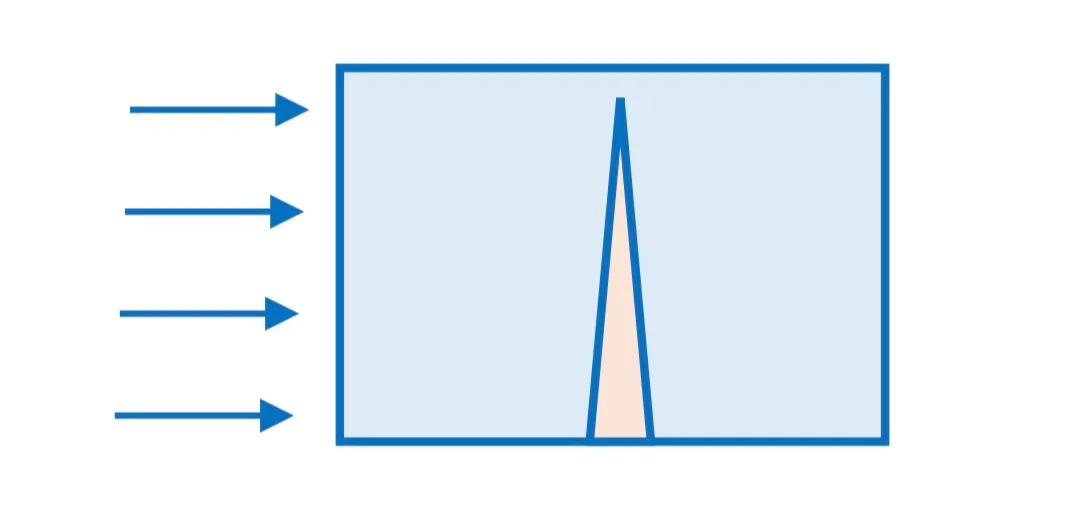
Options
JEE MainsJEE Advanced
Open question & full solution → - MCQeasyGeometrical optics
A thin prism P₁ with an angle 6° and made of glass of refractive index 1.54 is combined with another prism P₂ made from glass of refractive index 1.72 to produce dispersion without average deviation. The angle of prism P₂ is:
Options
JEE Mains30 January 2023Shift 2Evening Shift
Open question & full solution → - MCQeasyGeometrical optics
When a beam of white light is allowed to pass through convex lens parallel to principal axis, the different colours of light converge at different point on the principle axis after refraction. This is called :
Options
JEE Mains24 January 2023Shift 2Evening Shift
Open question & full solution → - MCQeasyGeometrical optics
A thin prism with angle 5° of refractive index 1.72 is combined with another prism of refractive index 1.9 to produce dispersion without deviation. The angle of second prism is ______.
Options
JEE Mains 202623 January Morning Shift
Open question & full solution → - MCQmediumGeometrical optics
The dispersive powers of the materials of the two lenses are in the ratio 4 : 3. If the achromatic combination of these two lenses in contact is a convex lens of focal length 60 cm then the focal lengths of the component lenses are
Options
JEE MainsJEE Advanced
Open question & full solution → - MCQdifficultGeometrical optics
A flint glass convex lens of focal length 16 cm is placed in contact with crown glass lens. The refractive indices of crown glass for violet and red colour are μv = 1.525, μr = 1.515 and for flint glass μv' = 1.655 and μr' = 1.645. (a) Find the nature and focal length of the crown glass lens which will form an achromatic combination with the flint glass lens. (b) What is the focal length of the combination?
Options
JEE MainsJEE Advanced
Open question & full solution →