Free physics question bank
friction and single block problem questions with solutions
Practice Newtons law of motion and Friction for JEE Main, JEE Advanced, NEET, and Classes 11–12. Attempt each question, then open it for the full solution.
Showing 1–10 of 73 questions
- MCQmediumNewtons law of motion and Friction
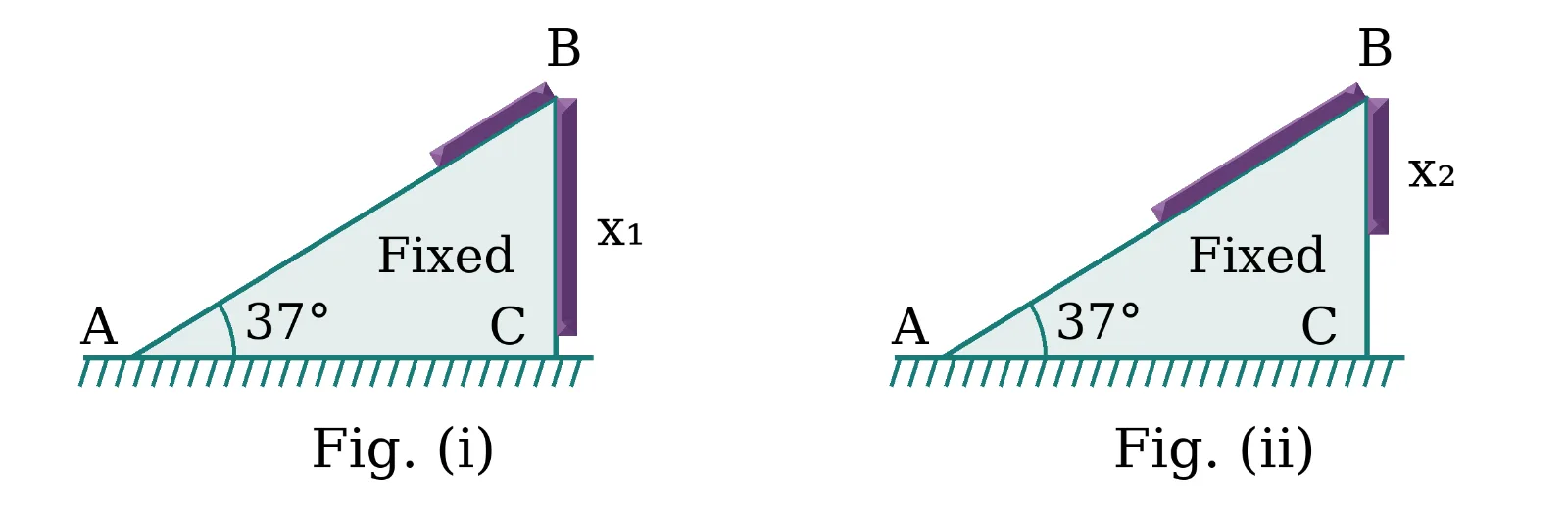
A uniform rope is placed over a triangular wedge whose base angle is 37°. The maximum hanging length in one limiting equilibrium configuration is x₁ and the minimum hanging length in the other is x₂. If x₁/x₂ = 3, find the coefficient of friction between rope and wedge.
Options
JEE Advanced
Open question & full solution → - IntegermediumNewtons law of motion and Friction
A bead slides down a vertical rod fixed inside a train accelerating horizontally at 4 m s⁻². The rod length is 1 m and μ = 1/2. If the time to reach the bottom is n/2 s, find n. Take g = 10 m s⁻².
JEE Mains
Open question & full solution → - MCQmediumNewtons law of motion and Friction
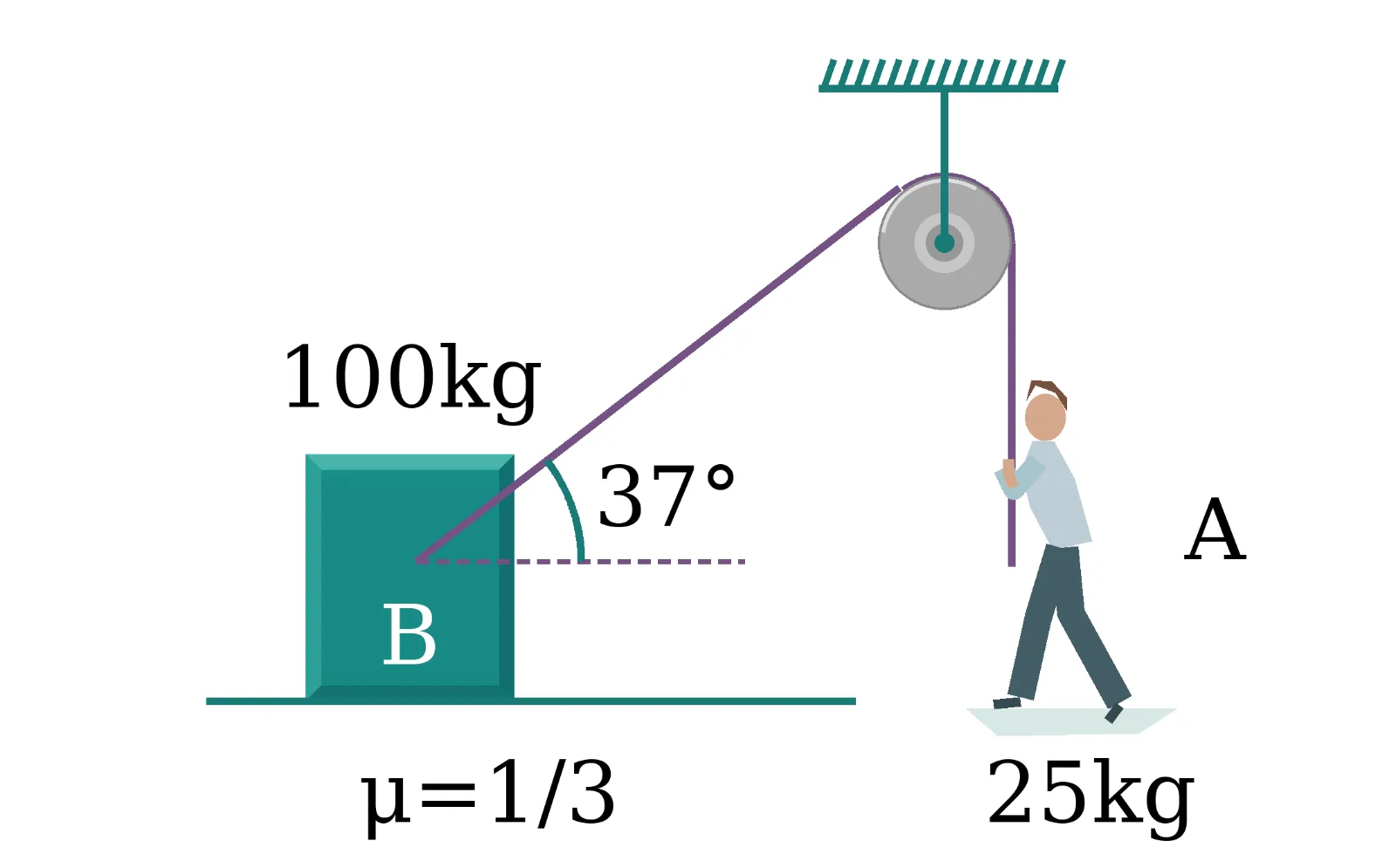
A 100 kg block B rests on a rough horizontal surface with μ = 1/3. A rope passes over a pulley and is climbed by a 25 kg boy A as shown. Find the maximum upward acceleration of the boy for which block B does not move.
Options
JEE Mains
Open question & full solution → - MCQdifficultNewtons law of motion and FrictionOpen question & full solution →
A block of mass m slides on a rough horizontal surface with coefficient of kinetic friction μ. A force F is applied at angle θ below the horizontal. Its acceleration is:
Options
- MCQdifficultNewtons law of motion and FrictionOpen question & full solution →
A 2 kg block is on a smooth incline of angle 37° which rises towards the right. A horizontal force F towards the right is applied so that the block remains at rest. Take g = 10 m/s², sin37° = 3/5 and cos37° = 4/5. F is:
Options
- MCQmediumNewtons law of motion and Friction
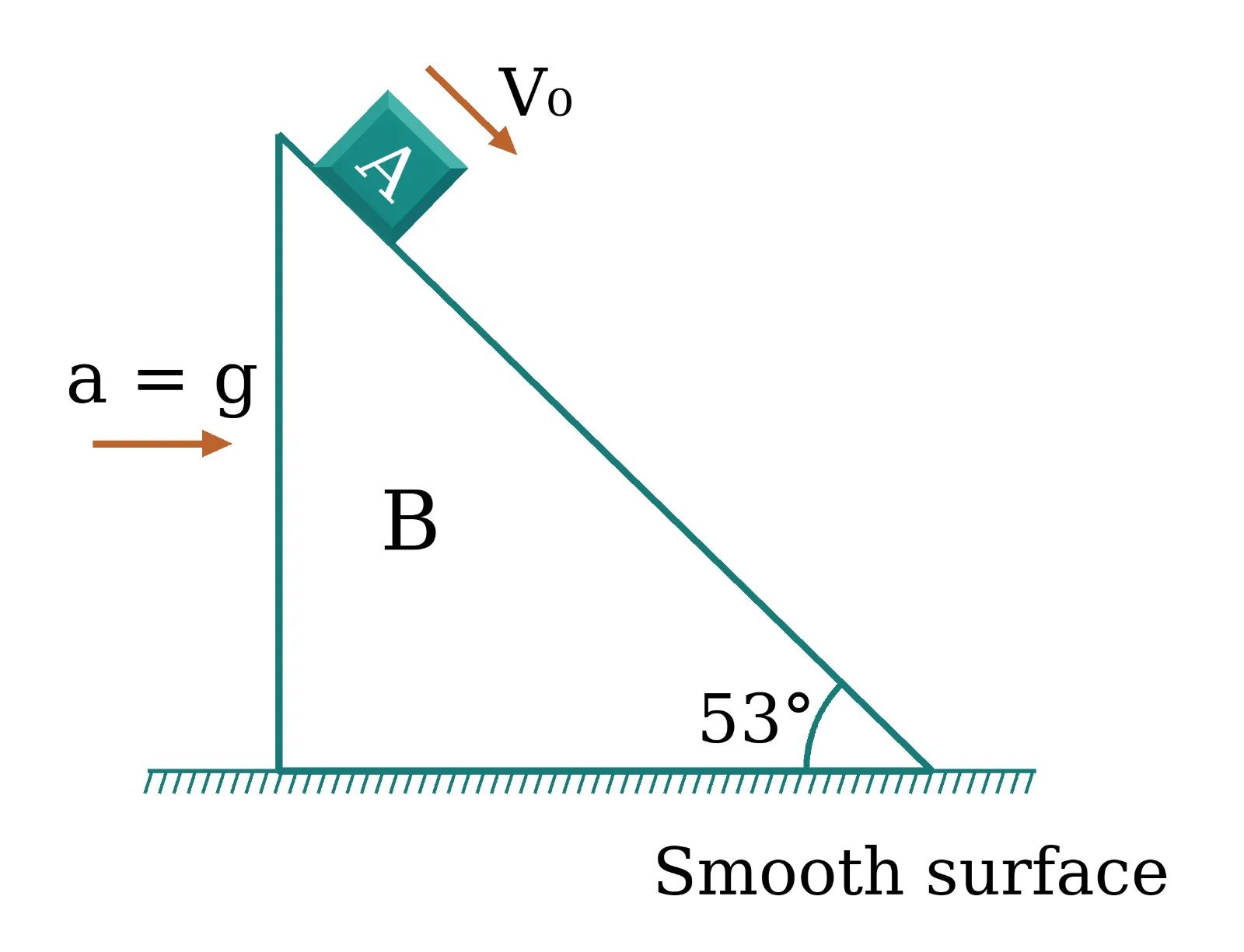
Block A is placed on a rough wedge B of inclination 53°. The wedge is on a smooth surface and is accelerated horizontally to the right with acceleration g. Block A is given an initial velocity relative to the wedge. Find the coefficient of friction for which A moves with constant velocity relative to the wedge.
Options
JEE Advanced
Open question & full solution → - MCQmediumNewtons law of motion and Friction
A block of mass m is placed on a surface whose vertical cross-section is y = x³/6. If the coefficient of friction is 0.5, the maximum height above the ground at which the block can be placed without slipping is:
Options
JEE Mains 2014
Open question & full solution → - Multi-correctmediumNewtons law of motion and Friction
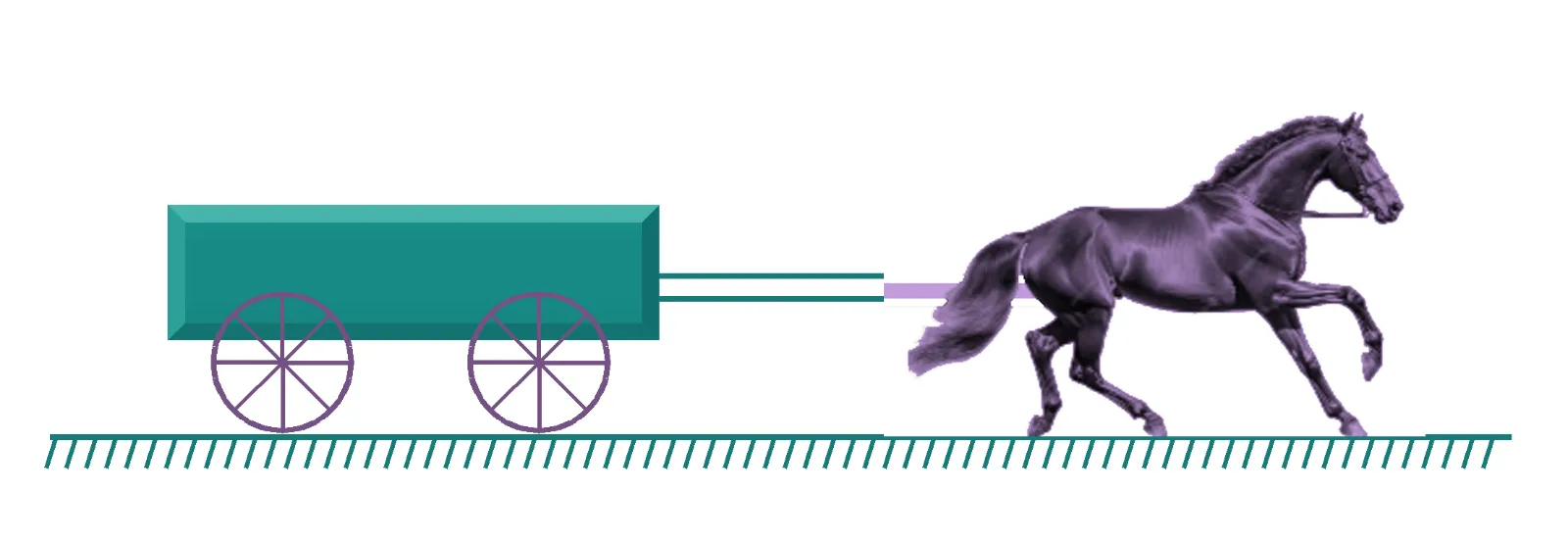
A horse pulls a cart on a rough surface. Taking (horse + cart) as one system, which statements are correct?
Select all that apply
JEE Advanced
Open question & full solution → - MCQeasyNewtons law of motion and Friction
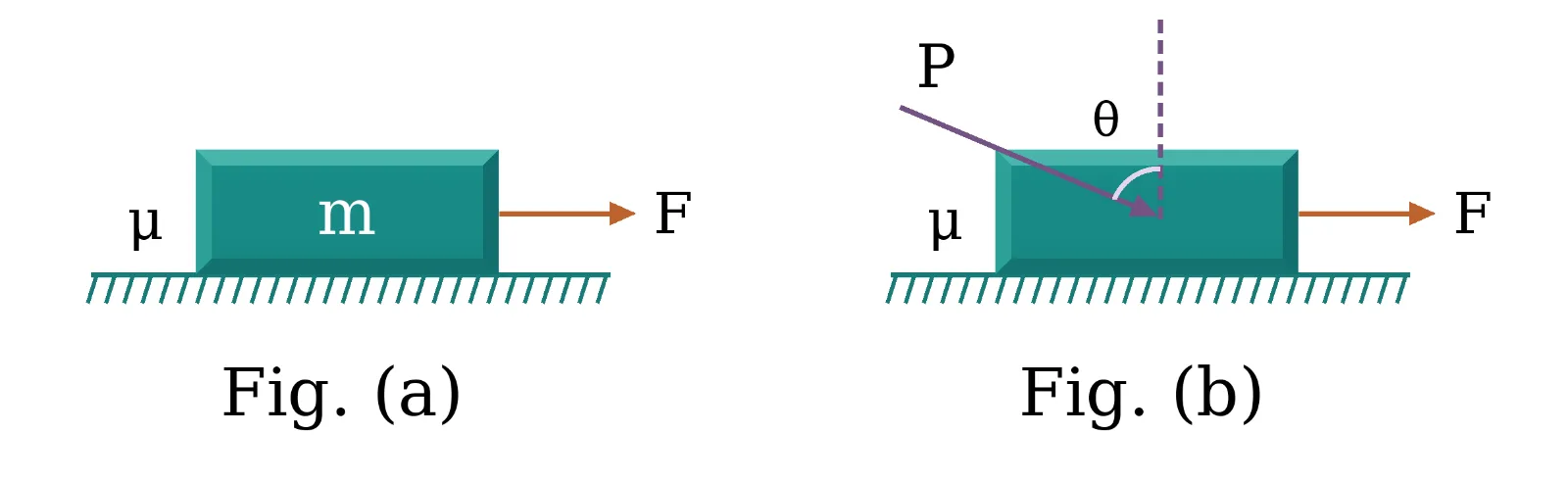
A block moves to the right on a rough horizontal surface under a horizontal force F. Later another force P is applied as shown, making an angle θ with the vertical such that tanθ = μ. After applying P, the acceleration of the block will:
Options
JEE Mains
Open question & full solution → - IntegermediumNewtons law of motion and Friction
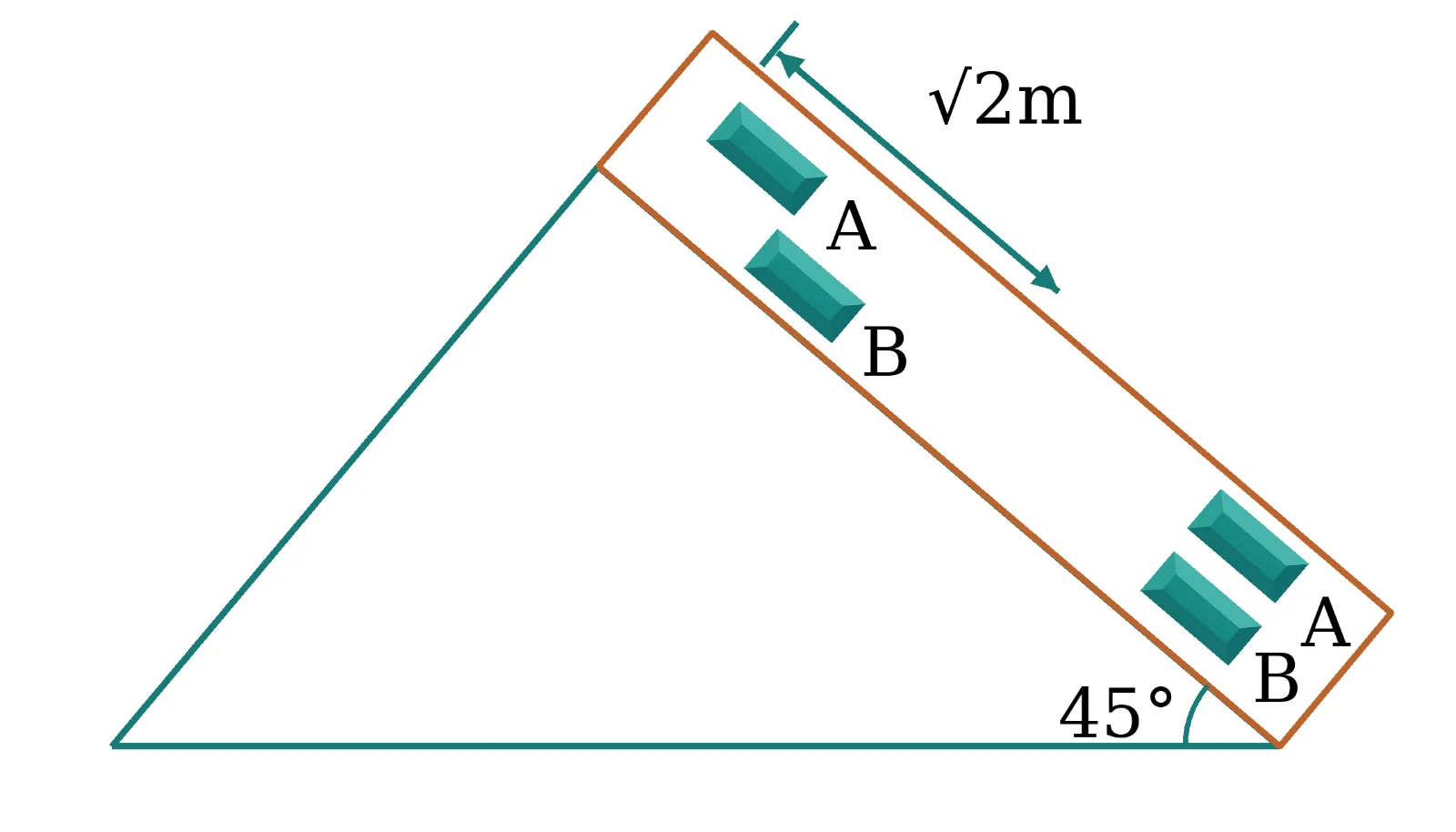
Two equal-mass blocks A and B are released simultaneously on the same rough 45° incline. Their coefficients of kinetic friction are 0.2 and 0.3, and A starts √2 m behind B. Find the time in seconds for A to catch B. Take g = 10 m s⁻².
JEE Advanced
Open question & full solution →