Free physics question bank
angular impulse in pure rotation and rotational collision questions with solutions
Practice Rotational Motion for JEE Main, JEE Advanced, NEET, and Classes 11–12. Attempt each question, then open it for the full solution.
Showing 1–10 of 20 questions
- MCQmediumRotational Motion
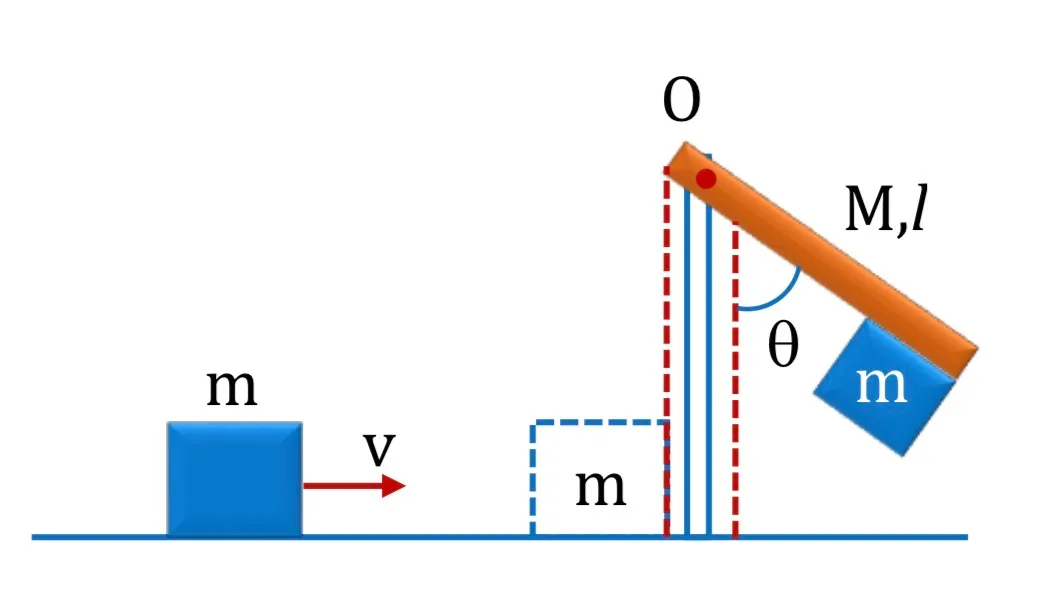
A block of mass m = 1 kg slides with velocity v = 6 m/s on a frictionless horizontal surface and collides with a uniform vertical rod and sticks to it as shown. The rod is pivoted about O and swings as a result of the collision making angle θ before momentarily coming to rest. If the rod has mass M = 2 kg, and length l = 1 m, the value of θ is approximately: (Take g = 10 m/s²)
Options
JEE Mains 2020
Open question & full solution → - MCQmediumRotational Motion
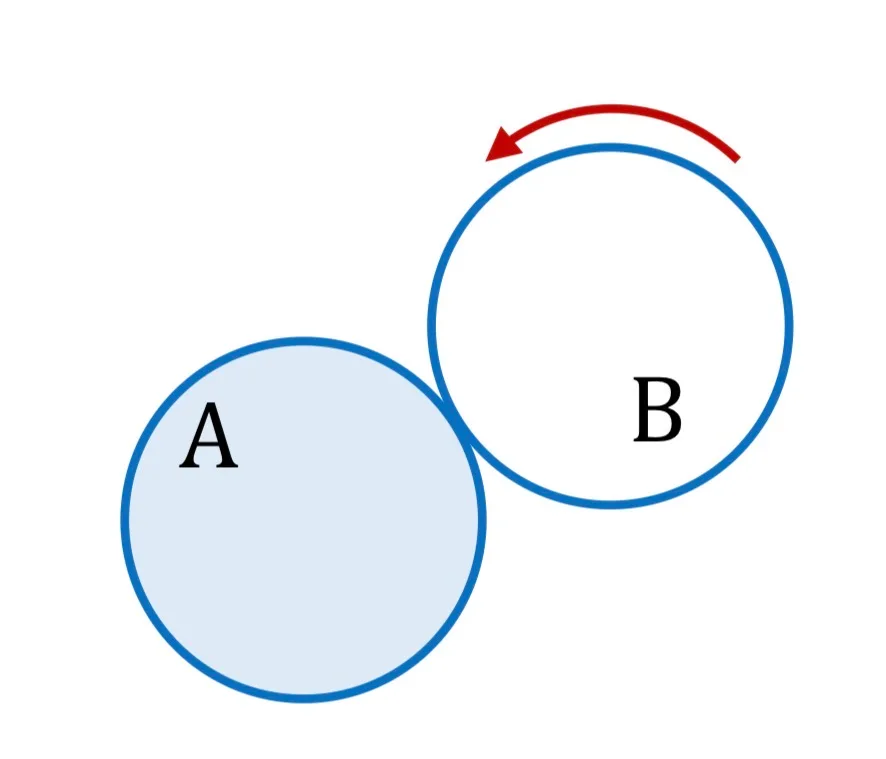
A flat surface of a thin uniform disk A of radius R is glued to a horizontal table. Another thin uniform disk B of mass M and with the same radius R rolls without slipping on the circumference of A, as shown in the figure. A flat surface of B also lies on the plane of the table. The center of mass of B has fixed angular speed ω about the vertical axis passing through the center of A. The angular momentum of B is nMωR² with respect to the center of A. Which of the following is the value of n?
Options
JEE Advanced 2022
Open question & full solution → - NumericmediumRotational Motion
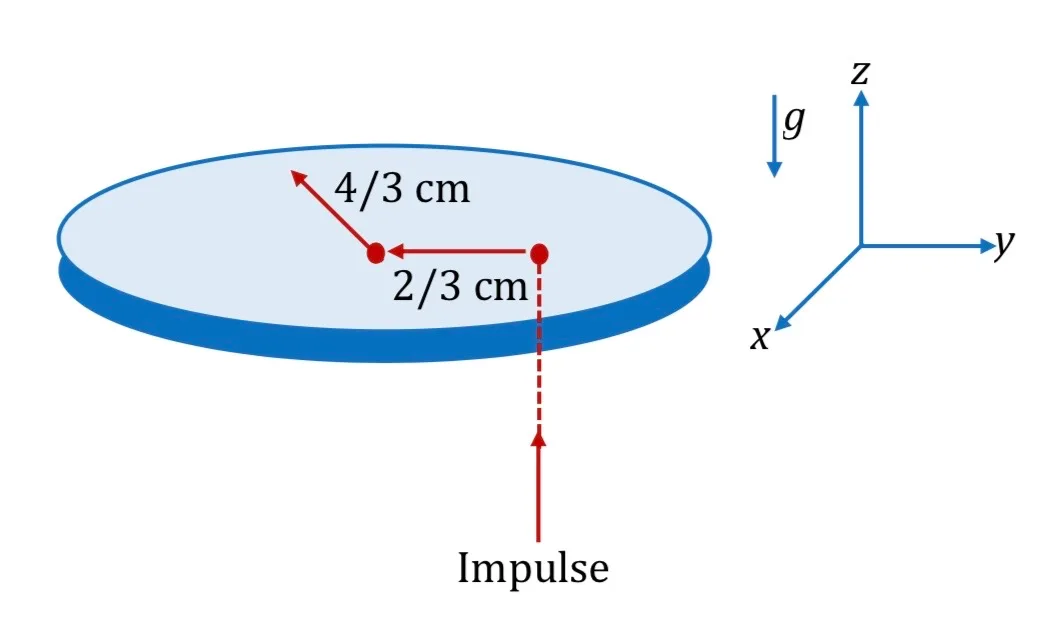
A thin circular coin of mass 5 g and radius 4/3 cm lies initially in the horizontal xy-plane. It is tossed vertically upward by an impulse √(π/2)×10⁻² N·s applied 2/3 cm from its centre. The coin spins about a diameter and moves along +z. By the time it returns to its initial height, it completes n rotations. Find n. Take g = 10 m s⁻².
JEE Advanced 2023
Open question & full solution → - NumericmediumRotational Motion
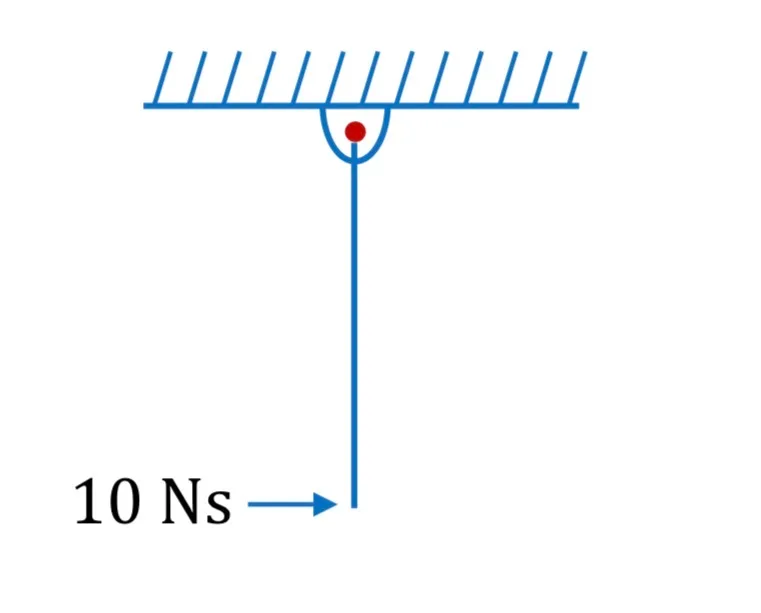
A thin uniform straight rod of mass 2 kg and length 1 m is free to rotate about its upper end when at rest. It receives an impulsive blow of 10 Ns at its lowest point, normal to its length as shown in figure. Find the kinetic energy of rod just after impact.
JEE Advanced
Open question & full solution → - MCQmediumRotational Motion
Two discs with the same moment of inertia I initially rotate at angular speeds ω₁ and ω₂ about their common axes. They are brought face-to-face and acquire the same final angular speed. Find rotational energy lost.
Options
NEET 2017
Open question & full solution → - MCQmediumRotational Motion
A thin circular ring of mass M and radius R rotates at angular speed ω. Two small particles each mass m are gently fixed at opposite ends of a diameter. Find final angular speed.
Options
AIPMT Mains 2010AIPMT Screening 2009NEET
Open question & full solution → - MCQmediumRotational Motion
A mass m is moving at speed v perpendicular to a rod of length d and mass M = 6m which pivots around a frictionless axle running through its centre. It strikes and sticks to the end of the rod. The moment of inertia of the rod about its centre is Md²/12. Then the angular speed of the system right after the collision is
Options
JEE MainsNEET
Open question & full solution → - MCQmediumRotational Motion
A bar of mass M = 1.00 kg and length L = 0.20 m is lying on a horizontal frictionless surface. One end of the bar is pivoted at a point about which it is free to rotate. A small mass m = 0.10 kg is moving on the same horizontal surface with 5.00 m·s⁻¹ speed on a path perpendicular to the bar. It hits the bar at a distance L/2 from the pivoted end and returns back on the same path with speed v. After this elastic collision, the bar rotates with an angular velocity ω. Which of the following statement is correct?
Options
JEE Advanced 2023
Open question & full solution → - MCQmediumRotational Motion
A disc of inertia I₁ spins at ωᵢ. A second coaxial disc of inertia I₂ initially at rest is dropped onto it. Both eventually spin at the same speed. Find mechanical energy lost through friction.
Options
AIPMT Screening 2010NEET
Open question & full solution → - MCQeasyRotational Motion
A thin ring of mass M and radius r rotates at angular speed ω. Four particles each mass m are placed gently at the opposite ends of two perpendicular diameters. Find final angular speed.
Options
AIPMT 2003NEET
Open question & full solution →