Free physics question bank
physical pendulam and torsional pendulam ,combination of shm questions with solutions
Practice Simple Harmonic Motion for JEE Main, JEE Advanced, NEET, and Classes 11–12. Attempt each question, then open it for the full solution.
Showing 1–10 of 17 questions
- MCQmediumSimple Harmonic Motion
A particle simultaneously executes two mutually perpendicular oscillations given by x = A cosωt and y = B cos2ωt. Which equation represents the trajectory after eliminating time?
Options
JEE MainsNEETJEE Advanced
Open question & full solution → - MCQmediumSimple Harmonic Motion
Two identical uniform rods, each of length L and mass m, are rigidly joined at right angles to form an L-shaped body. The body is pivoted at the free end of one rod and is free to oscillate in its own vertical plane. Which expression gives the angular frequency of small oscillations about the stable equilibrium?
Options
JEE MainsNEETJEE Advanced
Open question & full solution → - NumericmediumSimple Harmonic Motion
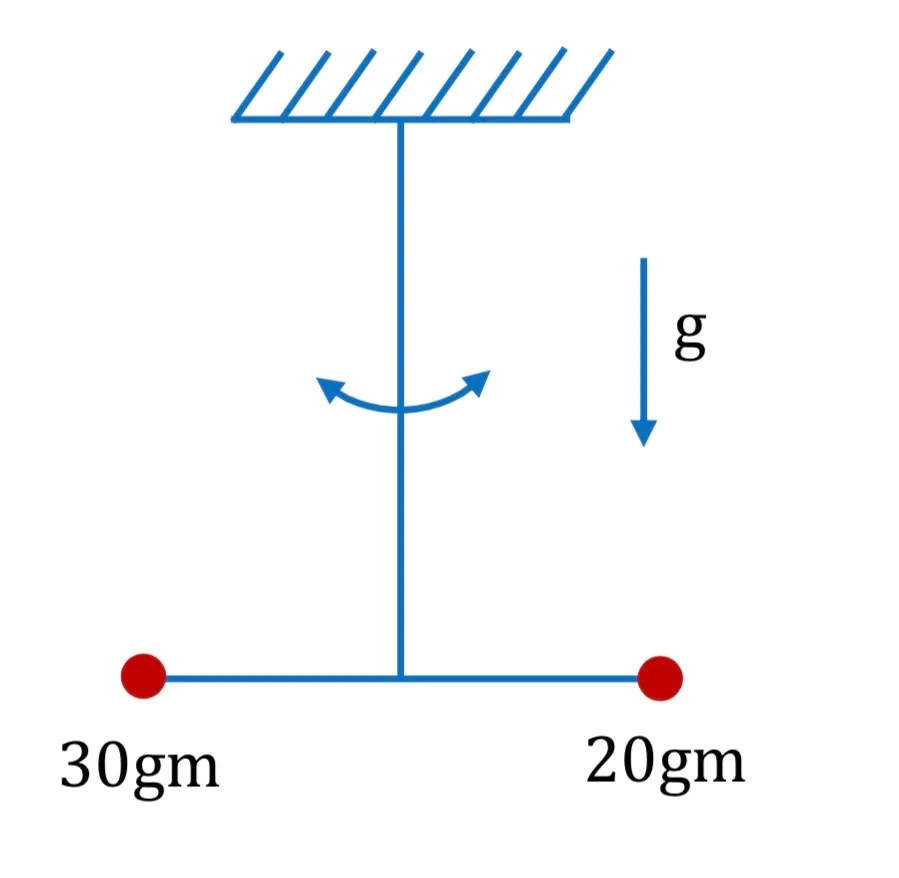
Two point-like objects of masses 20 gm and 30 gm are fixed at the two ends of a rigid massless rod of length 10 cm. This system is suspended vertically from a rigid ceiling using a thin wire attached to its center of mass, as shown in the figure. The resulting torsional pendulum undergoes small oscillations. The torsional constant of the wire is 1.2 × 10⁻⁸ N m rad⁻¹. The angular frequency of the oscillations is n × 10⁻³ rad s⁻¹. The value of n is [enter value].
JEE Advanced 2023
Open question & full solution → - MCQmediumSimple Harmonic Motion
A particle is subjected to two simple harmonic motions: x₁ = √7 sin(5t) cm and x₂ = 2√7 sin(5t + π/3) cm. The maximum acceleration is x×10⁻² m s⁻². The value of x is:
Options
JEE Mains 2025 2 April Morning Shift
Open question & full solution → - A/RmediumSimple Harmonic Motion
Choose the correct option for the following Assertion (A) and Reason (R).
Assertion
Two mutually perpendicular SHMs of the same frequency and phase difference π/2 produce an elliptical path in general.
Reason
Eliminating time from x = A cosωt and y = B sinωt gives x²/A² + y²/B² = 1.
Options
JEE MainsNEETJEE Advanced
Open question & full solution → - NumericmediumSimple Harmonic Motion
A thin ring of radius 0.50 m is suspended from a point on its circumference and oscillates in its own vertical plane. Take g = 10 m/s². If ω² = N s⁻², find N.
JEE MainsNEETJEE Advanced
Open question & full solution → - MCQmediumSimple Harmonic Motion
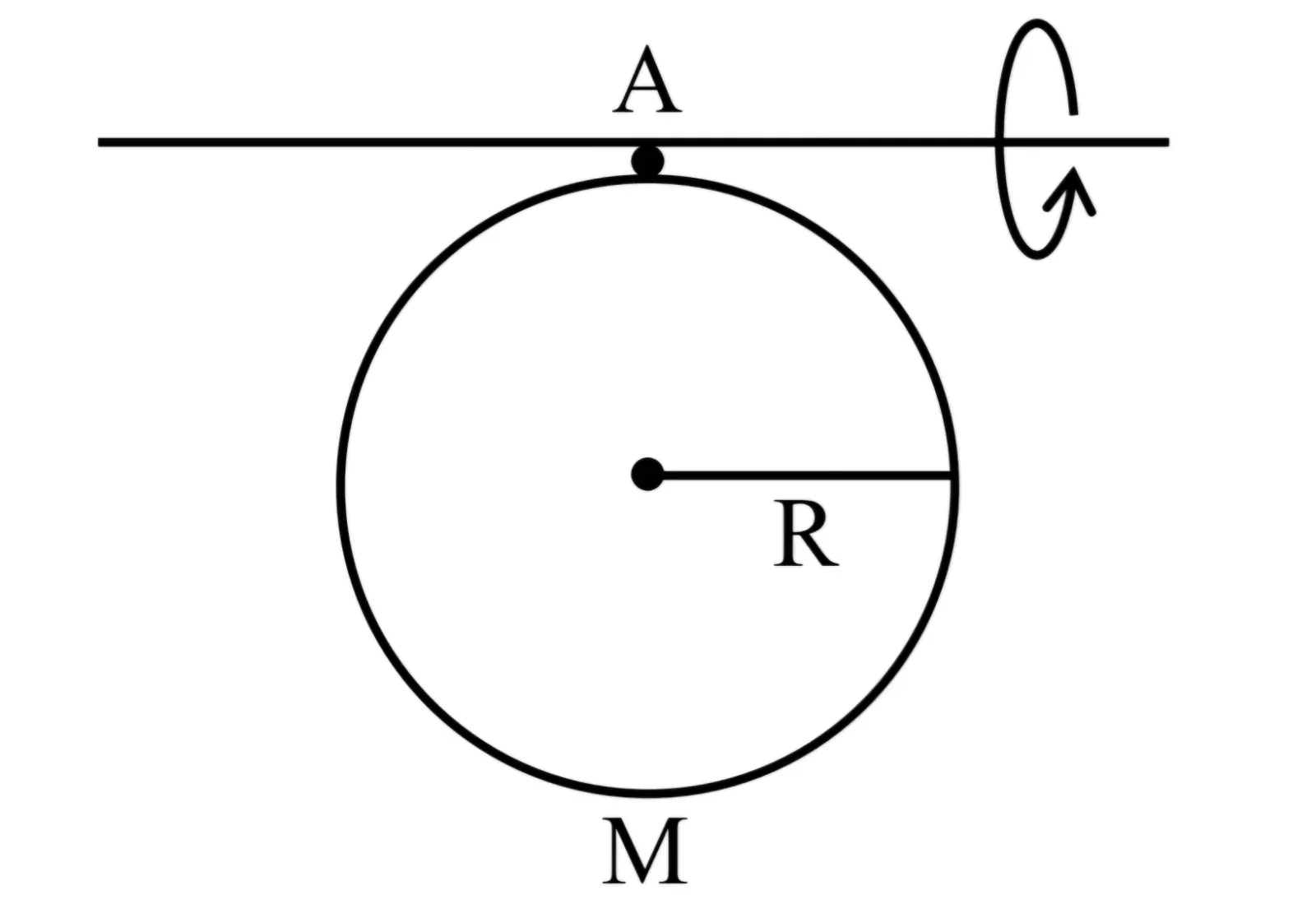
A uniform disc of mass M and radius R can oscillate in its own plane about a fixed horizontal axis passing through a point A on its rim, as shown in the figure. For small angular oscillations under gravity, what is its time period?
Options
JEE Mains 2026 4 April Evening Shift
Open question & full solution → - MCQdifficultSimple Harmonic Motion
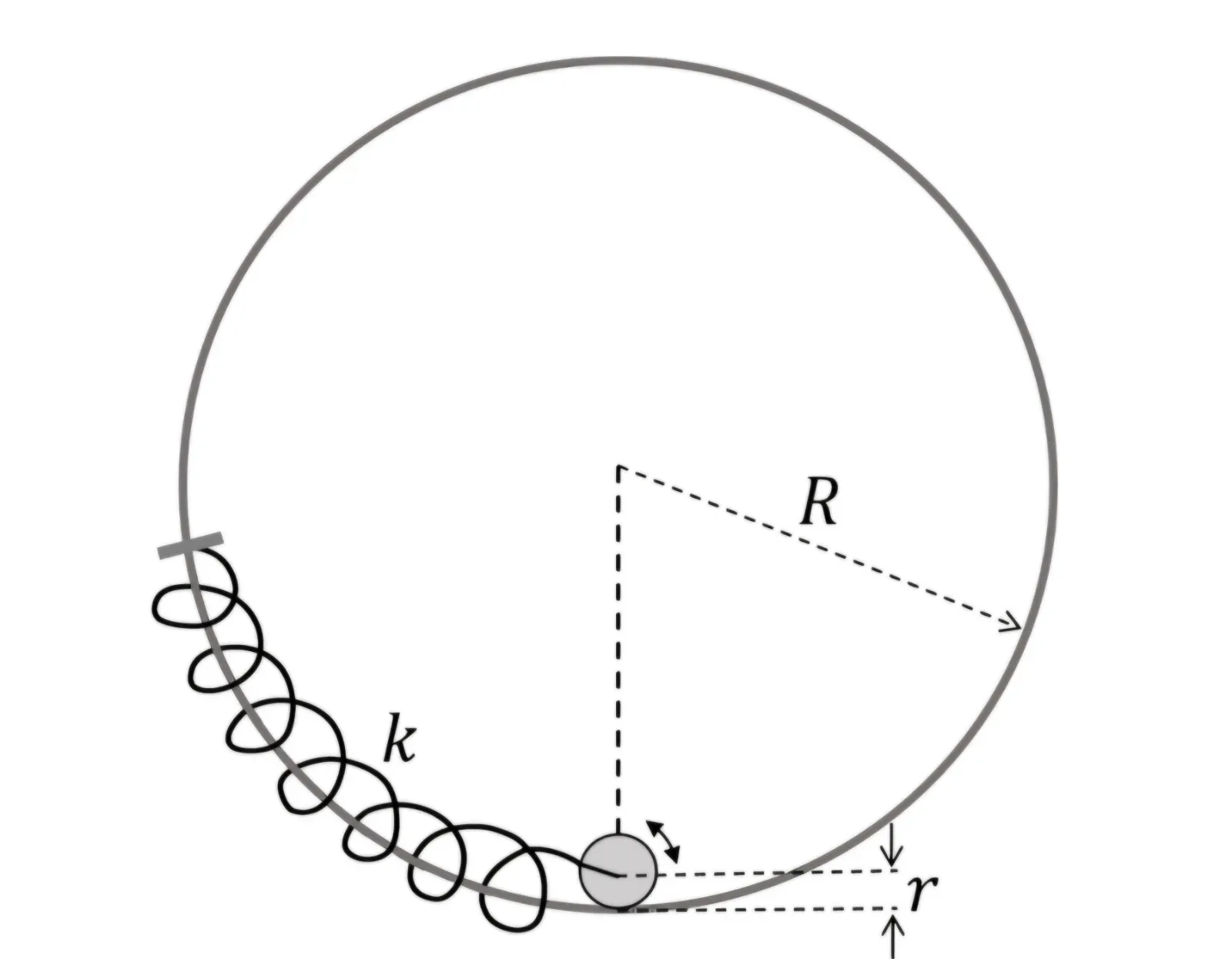
The center of a disk of radius r and mass m is attached to a spring of spring constant k, inside a ring of radius R > r. The disk rolls without slipping along the inside periphery of the ring. The spring follows the periphery of the ring and obeys Hooke's law. In equilibrium, the disk is at the bottom of the ring. For a small displacement, T = 2π/ω. The correct expression for ω is:
Options
JEE Advanced 2025 Paper 1
Open question & full solution → - NumericeasySimple Harmonic Motion
A body of moment of inertia 2×10⁻³ kg·m² is suspended by a torsion wire of torsional constant 0.18 N·m/rad. If the square of its angular frequency is N s⁻², find N.
JEE MainsNEETJEE Advanced
Open question & full solution → - NumericmediumSimple Harmonic Motion
A particle executes two perpendicular SHMs given by x = 3cos5t and y = 4sin5t, where x and y are in metres and t is in seconds. If its maximum resultant speed is N m/s, find N.
JEE MainsNEETJEE Advanced
Open question & full solution →