Free physics question bank
first law of thermodynamics questions with solutions
Practice Thermodynamics for JEE Main, JEE Advanced, NEET, and Classes 11–12. Attempt each question, then open it for the full solution.
Showing 1–10 of 26 questions
- A/ReasyThermodynamics
Given below are two statements. One is labelled as Assertion A and the other is labelled as Reason R.
Assertion
If dQ and dW represent the heat supplied to the system and the work done on the system respectively, then according to the first law of thermodynamics dQ = dU - dW.
Reason
First law of thermodynamics is based on law of conservation of energy.
Options
JEE Mains29 January 2023Shift 1Morning Shift
Open question & full solution → - MCQmediumThermodynamics
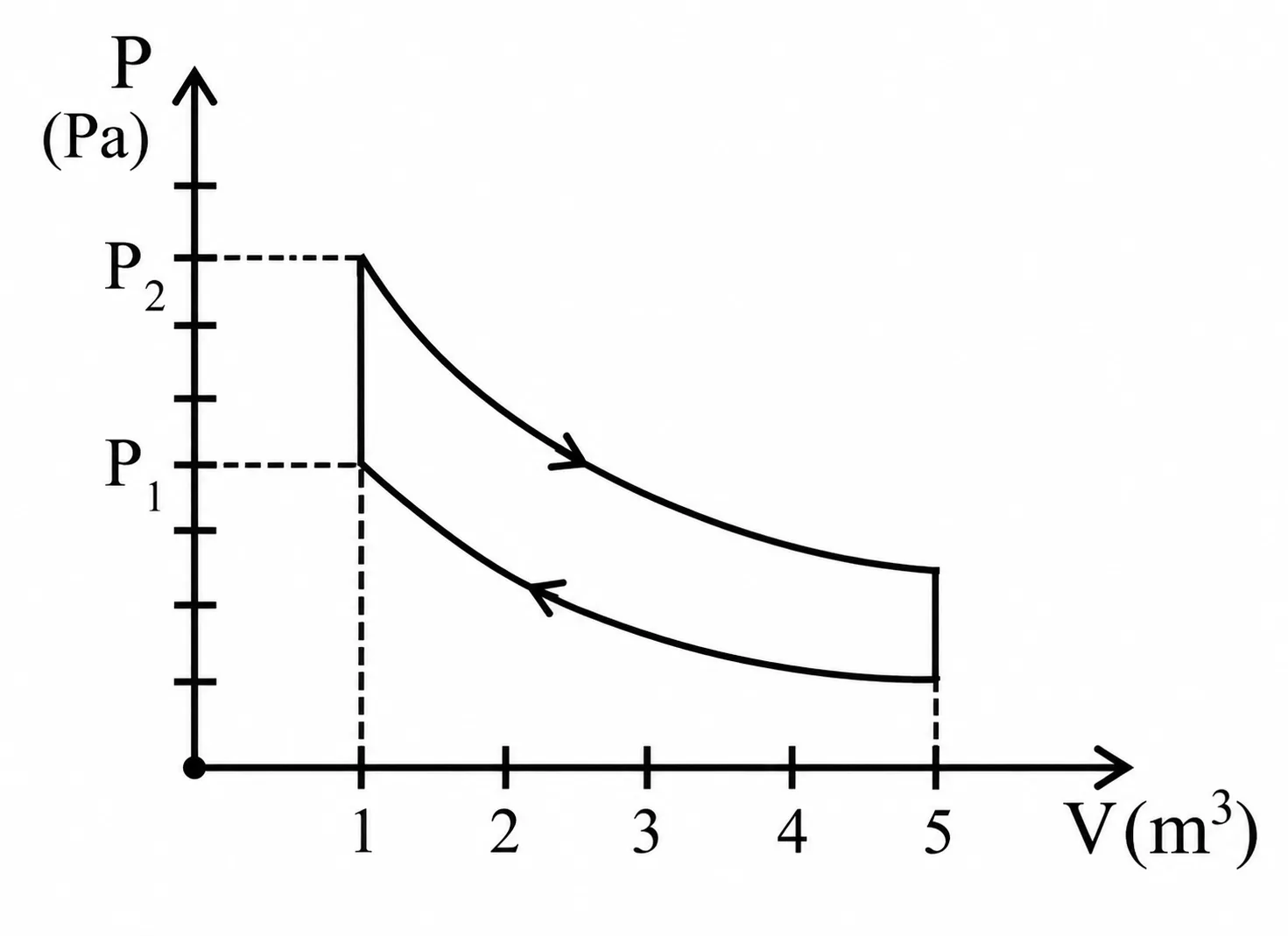
10 mole of an ideal gas is undergoing the process shown in the figure. The heat involved in the process from P₁ to P₂ is α Joule (P₁ = 21.7 Pa and P₂ = 30 Pa, Cv = 21 J/K·mol, R = 8.3 J/mol·K). The value of α is ____.
Options
JEE Mains 202624 January Evening Shift
Open question & full solution → - MCQmediumThermodynamics
One mole of an ideal diatomic gas expands from volume V to 2V isothermally at a temperature 27°C and does W joule of work. If the gas undergoes same magnitude of expansion adiabatically from 27°C doing the same amount of work W, then its final temperature will be (close to) __________ °C.
Options
JEE Mains 202623 January Evening Shift
Open question & full solution → - MCQmediumThermodynamics
One mole of an ideal diatomic gas is kept in a cylinder fitted with a frictionless piston. The piston area is 4 cm². The gas is heated slowly so that its temperature rises by 1.2°C, during which the piston moves outward by 25 mm. Atmospheric pressure is 100 kPa and R = 8.3 J·mol⁻¹·K⁻¹. Neglect the piston mass. Which listed value is the most suitable heat supplied ?
Options
JEE Mains 2026 8 April Evening Shift
Open question & full solution → - MCQeasyThermodynamics
In an adiabatic process, which of the following statements is true?
Options
JEE Mains 2025 2 April Morning Shift
Open question & full solution → - MCQmediumThermodynamics
Heat energy of 735 J is given to a diatomic gas allowing the gas to expand at constant pressure. Each gas molecule rotates around an internal axis but does not oscillate. The increase in internal energy of the gas will be:
Options
JEE Mains31 January 2023Shift 2Evening Shift
Open question & full solution → - MCQeasyThermodynamics
A diatomic gas (γ = 1.4) does 100 J of work in an isobaric expansion. The heat given to the gas is:
Options
JEE Mains 2024 08 Apr Evening Shift
Open question & full solution → - MCQmediumThermodynamics
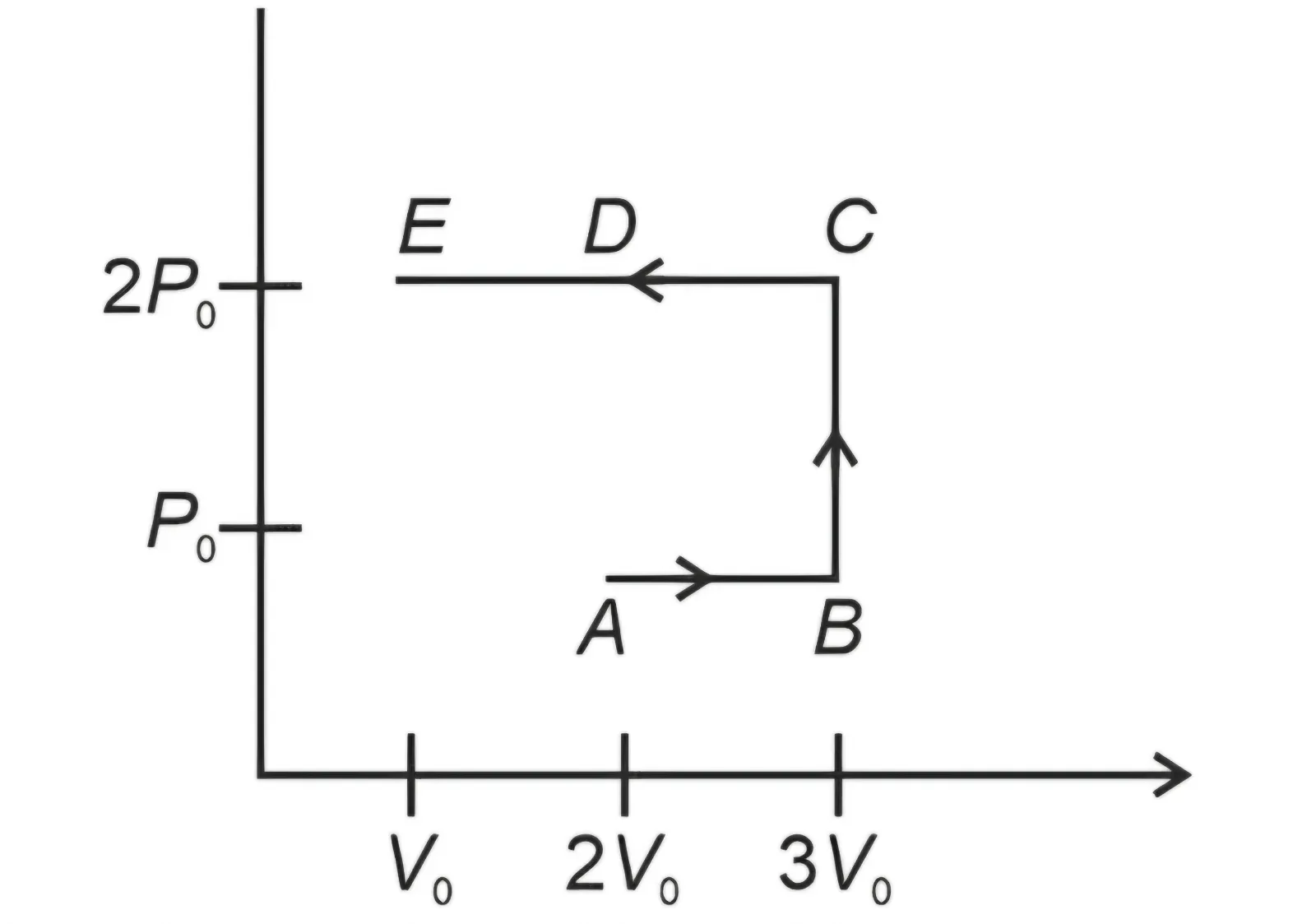
In the P–V diagram, a gas goes A(2V₀,P₀) → B(3V₀,P₀) → C(3V₀,2P₀) → D(2V₀,2P₀) → E(V₀,2P₀). Find the total work done by the gas from A to E.
Options
JEE Mains 2025 23 Jan Evening Shift
Open question & full solution → - MCQeasyThermodynamics
A source supplies heat to a system at the rate of 1000 W. If the system performs work at a rate of 200 W. The rate at which internal energy of the system increase is
Options
JEE Mains6 April 2023Shift 1Morning Shift
Open question & full solution → - MCQmediumThermodynamics
Consider the following statements about thermodynamics. A. The zeroth law of thermodynamics provides the concept of temperature. B. The first law of thermodynamics introduces the concept of internal energy. C. In an isothermal expansion of an ideal gas, the heat supplied is not equal to the work done by the gas. D. The product of an intensive variable and an extensive variable is extensive. E. The ratio of any extensive variable to mass is an extensive variable. Which combination contains only correct statements?
Options
JEE Mains 2026 5 April Morning Shift
Open question & full solution →